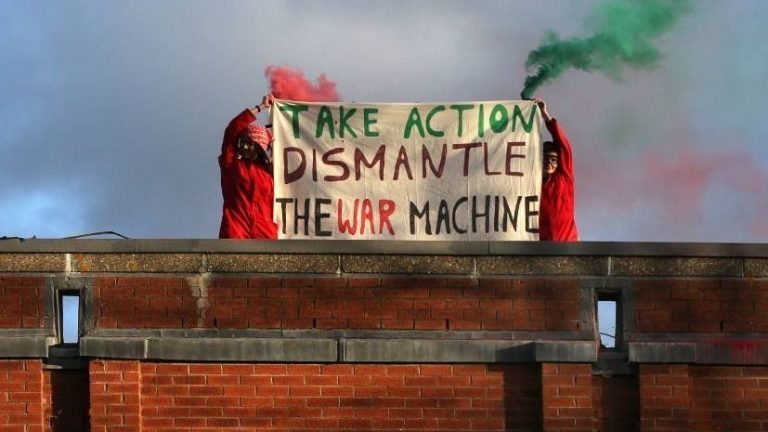
By Molly Wallace for Waging Nonviolence - Struggles against human rights abuses or militarism are rarely linked — in thought or discussion — to humor. As serious matters, they deserve serious, strategic thinking about how to dismantle the power structures that enable them. But what if humor itself is a powerful tool for doing so? In “Laughing on the Way to Social Change,” in the January 2017 issue of Peace & Change, Majken Jul Sørensen explores this possibility in the context of three recent examples of activism in Sweden and Belarus, asking how the use of humor affects the way nonviolent action operates — particularly its ability to disrupt dominant discourses and therefore challenge power. In the first example, two Swedish activists flew an airplane through Belarusian airspace, dropping 879 parachuted teddy bears with signs reading, “We support the Belarusian struggle for free speech.” A response to an earlier action where Belarusian activists assembled stuffed animals in a central square — bearing signs like, “Where is freedom of the press?” — the parachuting bears ultimately resulted in two Belarusian officials being fired. The second and third involved a Swedish anti-militarist network called Ofog, or “mischief.” In response to NATO military exercises in Sweden, Ofog created a “company” whose purpose was to make these exercises more realistic by providing civilian casualties.